



THE media frenzy around the summer's partial eclipse of the sun left many feeling underwhelmed.
We need to go back 99 years to find the real deal here in Craven; we also need a soupçon of science.
The question is not “Why do solar eclipses happen?”, but rather, “Why don’t they happen every month?”
The earth takes a year to orbit the sun, and the moon takes a month to orbit the earth.
The moon should therefore be between the earth and the sun once every month: when it happens the distances apart and sizes of the moon and sun are sometimes just right so that the main body of the sun is blocked from view, the sky goes dark and, for just a few minutes or so, viewers can see the sun’s brilliant corona or outer atmosphere.
So why don’t we see a total eclipse every month?

The answer is that the moon’s orbit is ever-so-slightly tilted and sometimes the moon is too high and sometimes it is too low and the Goldilocks “just right” event takes place only once every few hundred years.
That is why the eclipse of 1927 was so special and it took place here.
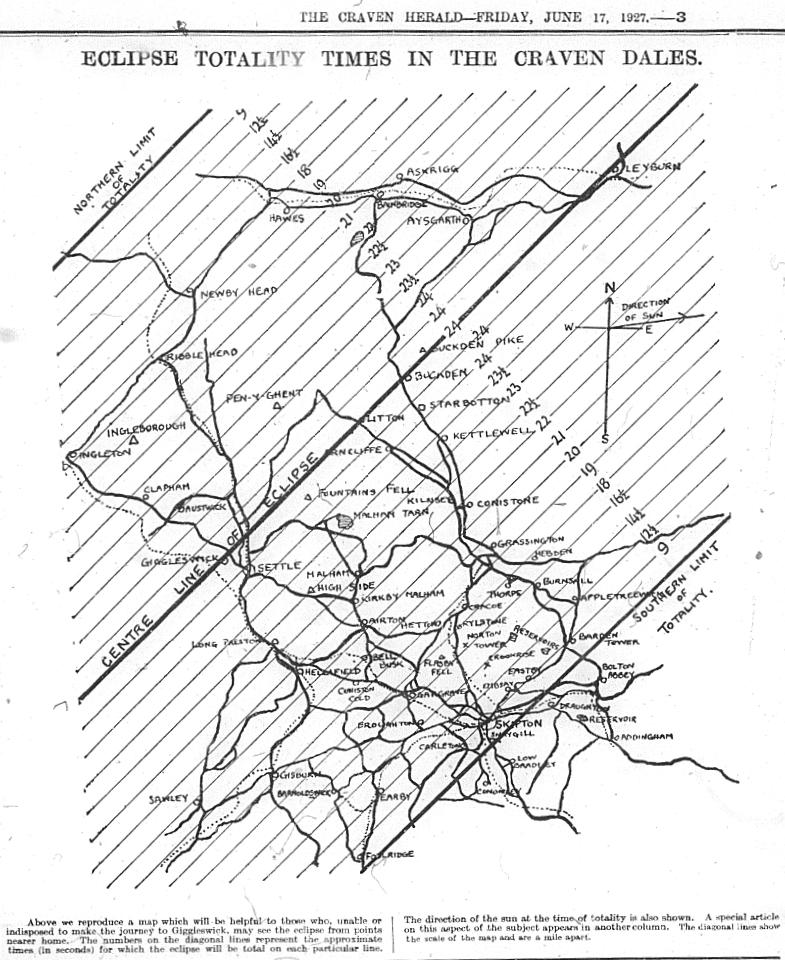
The map shows the course of the eclipse.
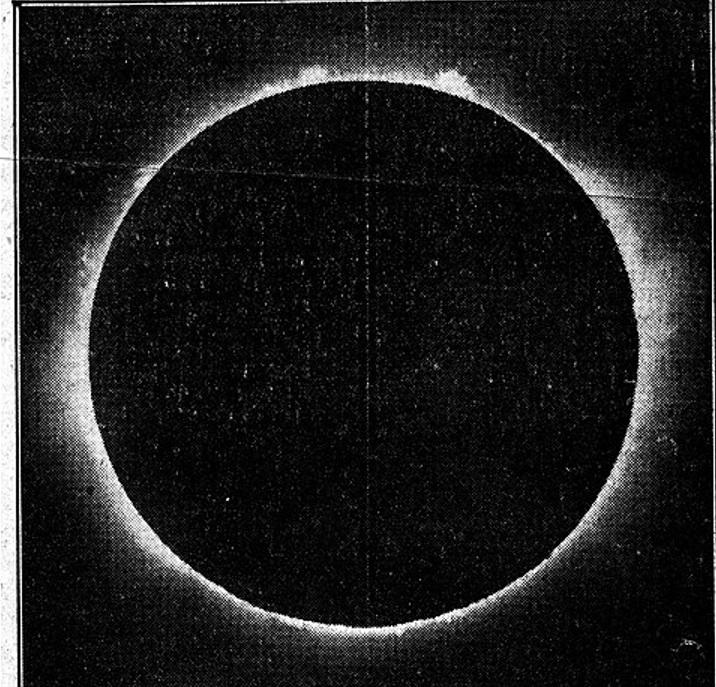
At Giggleswick School the total eclipse lasted for 24 seconds, long enough for guest of honour, Astronomer Royal, Sir Frank Dyson to photograph it.
At Barnoldswick the total eclipse lasted 15 seconds and just nine seconds in Skipton.
At Stonyhurst College near Clitheroe, astronomers in the observatory had their view obscured by clouds, unlike the pupils on the cricket pitch just 250 yards away.
The Craven Herald loved it.
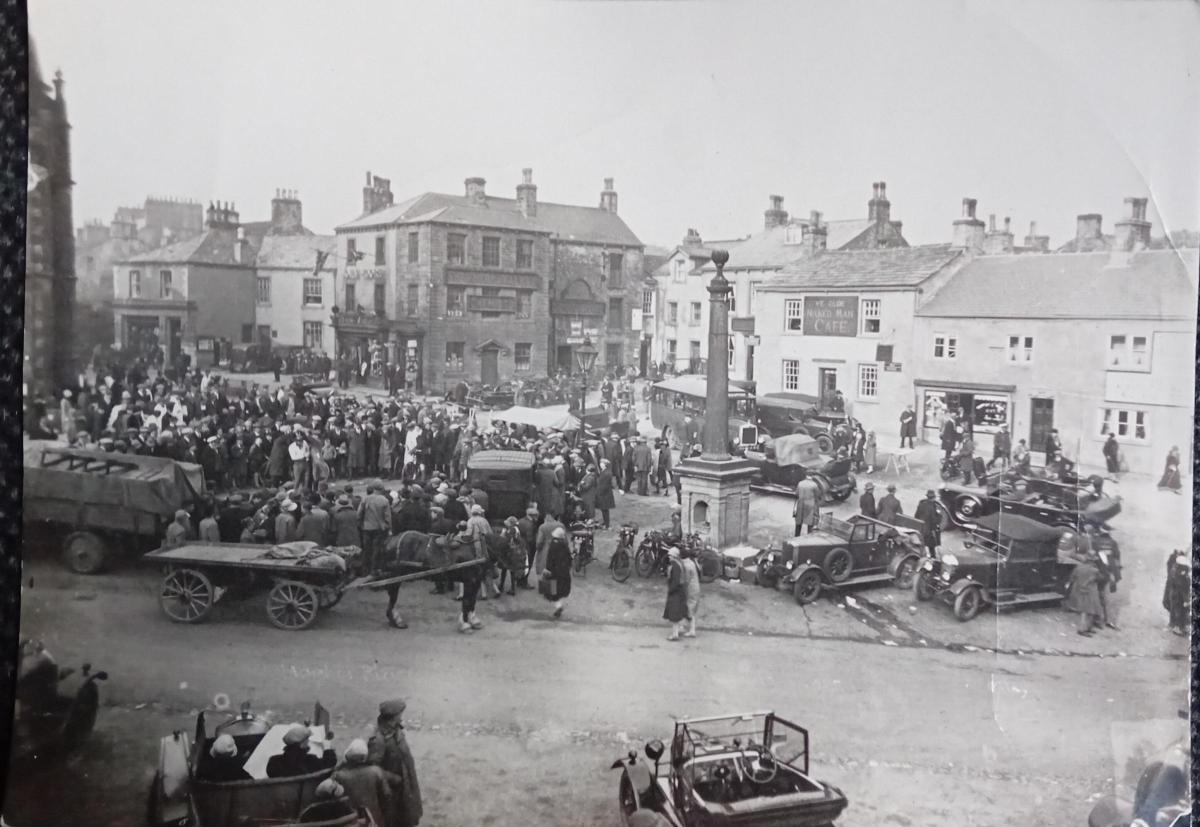
“A never-to-be-forgotten spectacle: never since the Craven hills and dales assumed their present form at the hands of mighty Nature have such scenes been witnessed as were seen on Tuesday night and Wednesday morning. As if pursued by some hideous terror, crowds [rushed] through Skipton’s High Street to vantage points for viewing the sun’s eclipse. They came a-wheel and a-foot in one apparently never-ending stream to an accompaniment of hurtling wheel and shrieking exhaust.
Wherever they went they were not disappointed, for they saw a manifestation of nature’s mysterious workings that can never be forgotten. Though predictions of failure were general owing to the cloudy conditions, promptly to the time scheduled the eclipse programme commenced and took the appointed [course] as the astronomers said it would. Whether seen from the Scars above Giggleswick, the Grassington and Kettlewell hills, Malham Moors, Buckden Pike, or the less elevated landmarks in the neighbourhood of Skipton and other places on the line of totality, all agreed that the scene was worth all the trouble and expense that had been involved – and was immeasurably impressive and beyond the power of mere words to describe.”

There was more: “Surrounded practically on all sides by hills and well within the favoured belt Barnoldswick provided an excellent place of observation… Barnoldswick was indeed a lively place on Tuesday night, many people remaining out of bed throughout. An all-night dance embracing the hours between 12 o’clock midnight and 5 a.m. had been arranged by Mossley’s Dance Band at the Queen’s Hall. The road traffic has probably never been as great during the whole history of the town. At 4.30 [in the morning] a large party of pupils from the Colne Secondary School arrived by special train. About 50 scholars of St. Joseph’s School viewed the eclipse from the Wheets. It was not until the sounding of hooters announced the start of work time that many began to move in the direction of home.”
“At most places a complete view of the eclipse was obtained though in several cases observers had the annoying experience of having their view obstructed by passing clouds during the period of totality…”
The last total solar eclipse in the United Kingdom was in Cornwall in 1999.
I had a seat booked on a special overnight train from Scotland to Penzance.
It was very expensive.
I’d looked forward to the date since childhood.
The weather forecast was for heavy cloud.
What was I to do?
After I cancelled the trip, the television announcer said that there might be micro-climatic effects and the cloud might clear because of the cooling effects of the eclipse.
It didn’t.
At exactly nine minutes past seven in the evening of August 12 this year I went to inspect the partial eclipse which covered over 90 percent of the sun.
The sky appeared to be darker in colour but it didn’t seem that dark outside.
My eyes were playing tricks, adapting to the low light.
I needed an accurate scientific instrument like a… daisy.
The daisy is the eye of the day: it opens in the light and closes in the dark.
It’s called a biological indicator.
And yes, the daisies had started to close early.
They were two-thirds shut.
Wait until the next total eclipse in the UK on September 23, 2090.
Hope for good weather.
Remember don’t look directly at the sun.
Use special viewers, but do remember to check out the daisies.


Share